

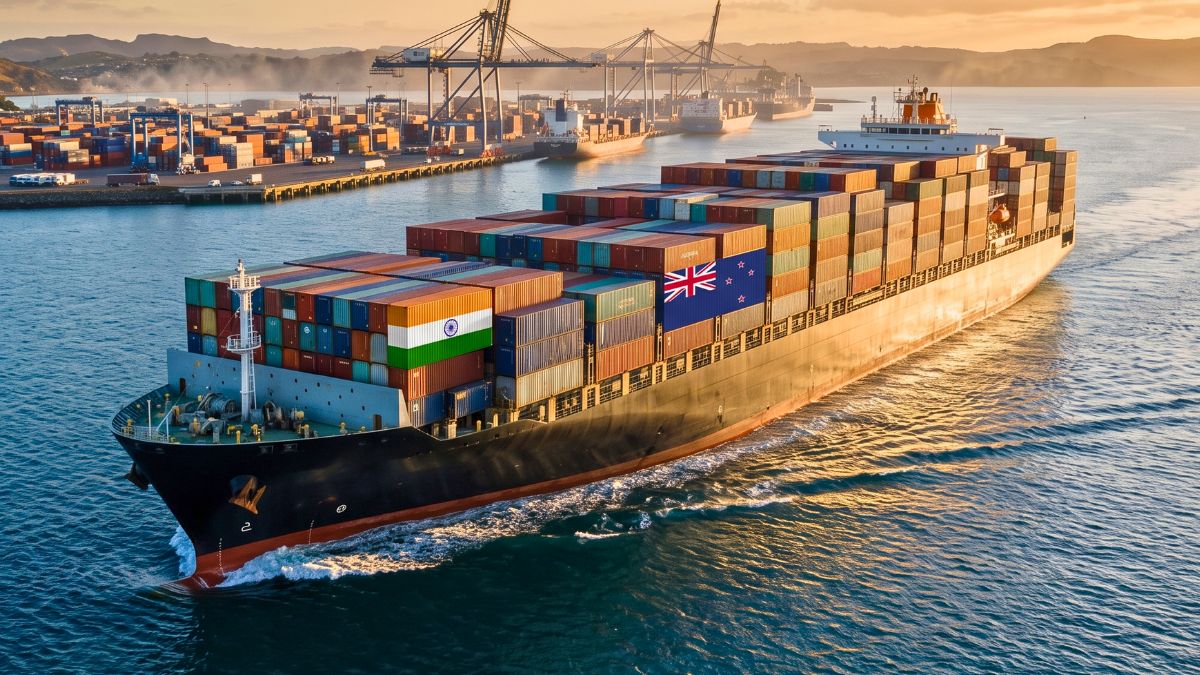
The free trade agreement between India and New Zealand takes effect this week, which coincides with Dussehra. It gives all Indian exports duty-free access to the New Zealand market.
Commerce and Industry Minister Piyush Goyal announced the date during a virtual interaction with New Zealand Trade and Investment Minister Todd McClay. The pact was signed in New Delhi on April 27 after nine months of negotiations, and New Zealand’s Parliament passed the implementing legislation on September 16. Both countries ratified the agreement on September 21, when McClay exchanged the formal documents with India’s High Commissioner to New Zealand, Muanpuii Saiawi.
Under the deal, 100% of Indian exports will enter New Zealand duty-free from day one, covering all tariff lines. Some Indian products had earlier faced New Zealand tariffs of up to 10%. Goyal said the opening would benefit sectors including textiles and apparel, leather and footwear, engineering goods, pharmaceuticals and processed food.
India will cut or eliminate tariffs on 95% of New Zealand’s exports. McClay said 57% of New Zealand’s exports to India, including wool and coal, will be tariff-free from the first day. More than 95% of its forestry and wood exports will also get duty-free access, and a second round of tariff cuts is due on January 1, 2027. New Zealand apples and kiwifruit will enter India through quota arrangements with minimum import prices and seasonal windows. India has kept several farm products out of the concessions, including onions, chana, peas, corn and almonds.
New Zealand has also committed to facilitate $20 billion of investment into India over the next 15 years. The agreement includes provisions for professional, student and youth mobility, and the two governments have set an aspirational goal of nearly doubling bilateral trade in goods and services within four to five years. India is New Zealand’s 12th-largest export market, with trade valued at $2.15 billion in the year to June 2025.
New Zealand Prime Minister Chris Luxon called the agreement one of the proudest things he has done in office. New Zealand High Commissioner Patrick John Rata described it as a huge development for both countries.
