

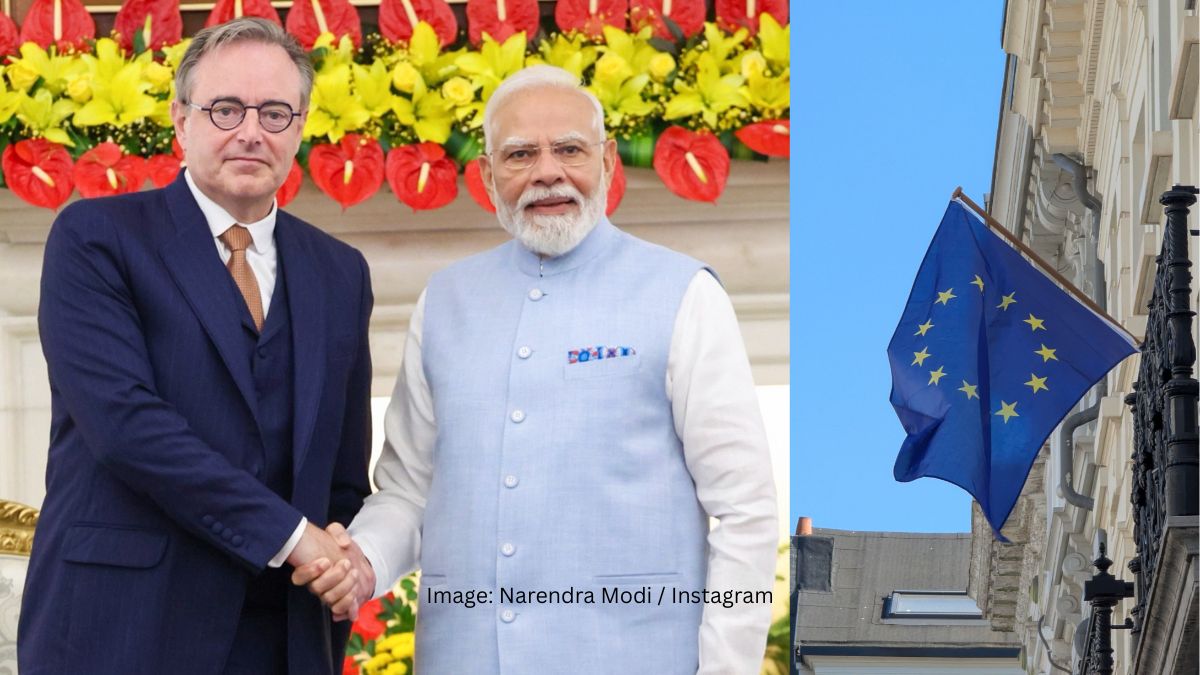
It is not often that a European leader stands in Delhi and openly admits his own continent got something badly wrong while India got it right. That is essentially what Belgian Prime Minister Bart De Wever did this week, and the confession he offered says as much about Europe’s current economic anxieties as it does about India’s growing diplomatic standing.
Speaking at a Confederation of Indian Industry event in Delhi, De Wever told the room plainly that India had recognised the risks of economic overdependence on China long before Europe did, and had tried to warn European countries about the consequences. India saw this earlier than we did, he said, and we didn’t listen. He went further still, crediting Prime Minister Narendra Modi personally with having flagged the danger years ago, only to be ignored at the time.
De Wever did not name China directly in his broader remarks, though the reference was unmistakable. He described Europe’s recent experience as a rude awakening, pointing to years in which the continent watched overcapacity get dumped below cost into its markets, its industrial base steadily undermined, and dependencies deliberately built up to the point where they could later be used as leverage.
That complaint is not simply rhetorical. European Commission figures published this year found more than 100 categories of goods had seen sharp, increases in shipments from China during the first half of the year, with import volumes of some products, including a chemical widely used in paint thinners, rising by well over 2,000 percent compared to the previous year and arriving at prices roughly 30 percent cheaper. Air conditioner imports climbed sharply too, arriving cheaper even as European heatwaves pushed domestic demand higher.
Brussels has already imposed provisional duties on categories of Chinese steel in response to similar pricing complaints, and officials have separately warned they will not tolerate a comparable flood of cheap Chinese electric vehicles. China, for its part, has pursued its own anti dumping investigation into European pork exports, a move widely viewed in Brussels as retaliation for the EU’s tariffs on Chinese electric vehicles.
De Wever used the moment to make a broader pitch for realigning Belgium’s, and by extension Europe’s, trading relationships around reliability rather than simple cost. India is No. 1 on our list, he said, arguing that any country without India on its own list of priority partners was missing something fundamental. He questioned the wisdom of leaning on trade partners capable of abruptly changing policy or imposing tariffs without warning, framing predictability itself as a strategic asset in an increasingly unstable global trading environment.
The remarks landed alongside a substantial expansion of the India-Belgium relationship on the security side. Belgium has reportedly assured India it will not supply critical military hardware to Pakistan, a signal delivered as the two countries move toward closer defence industrial cooperation. Ten separate agreements between Indian and Belgian defence industries were finalised alongside the Modi-De Wever talks, with some expected to cover joint production of military equipment, including rockets, inside India using Belgian technology. The two sides also agreed to expand military training exchanges and deepen intelligence sharing, with Modi describing defence and security cooperation as a key pillar of the broader relationship.
Public admissions of strategic miscalculation from a sitting European leader are rare, and De Wever’s willingness to make one so explicitly reflects just how seriously Chinese trade practices are now being taken across the continent. For India, being singled out as the country that saw the risk first adds real diplomatic weight to a relationship Modi’s government has spent years trying to deepen, and the accompanying defence agreements suggest Belgium, at least, is prepared to back that recognition with concrete commitments rather than simply favourable rhetoric.
