

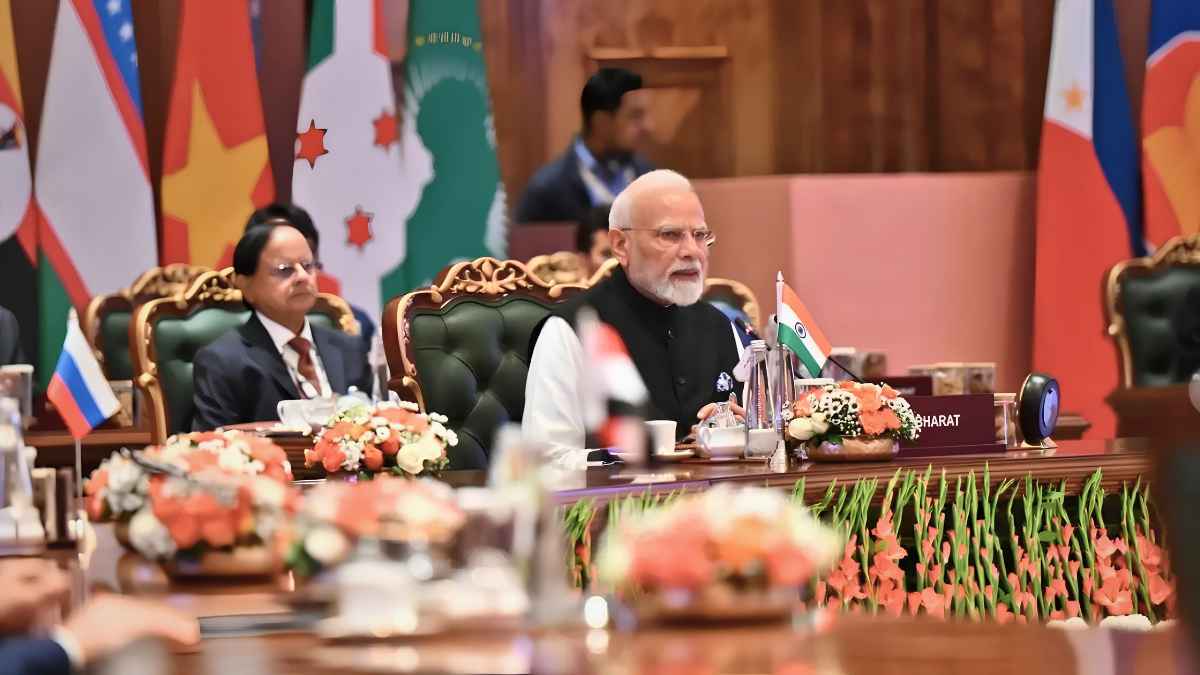
Prime Minister Narendra Modi warned on Sunday against the weaponisation of technology and critical minerals, cautioning that such practices could hinder shared global progress, as he addressed the concluding session of the 18th BRICS Summit in New Delhi.
Speaking at Bharat Mandapam, in the presence of Chinese President Xi Jinping, Russian President Vladimir Putin, Iranian President Masoud Pezeshkian and other BRICS leaders, Modi said rising geopolitical tensions were having a serious negative impact on ordinary people around the world. He said the bloc needed to come together through cooperation and inclusive growth to meet these challenges, adding that developing nations increasingly look to BRICS because their voices are heard and solutions are shaped in partnership with them rather than imposed from outside.
Addressing the specific concern directly, Modi said the weaponisation of technology and critical minerals could hinder shared progress and prosperity, and stressed that this was why the grouping had placed emphasis on inclusivity in how technology is adopted and shared among member nations. He also pointed to steps taken during India’s presidency of the bloc, including a new BRICS Logistics Supply Chain Cooperation Framework aimed at making supply chains more reliable and resilient, along with a proposed BRICS Startup Innovation Fund and a BRICS Incubator Network to connect start-ups across member countries.
Modi’s remarks echo comments he made at last year’s BRICS Summit in Rio de Janeiro, where he said no country should weaponise critical minerals, technology or supply chains for its own selfish gain, a statement widely read at the time as a veiled reference to China’s dominant hold over global rare-earth processing and its export restrictions. India has since moved to diversify its own critical mineral partnerships, including a rare-earth supply chain agreement signed with Brazil in February this year.
The 18th BRICS Summit, held over two days in New Delhi, brought together a bloc that now represents around 49.5% of the world’s population and roughly 40% of global GDP, concluding with new initiatives spanning supply chains, start-ups and digital agriculture.
