

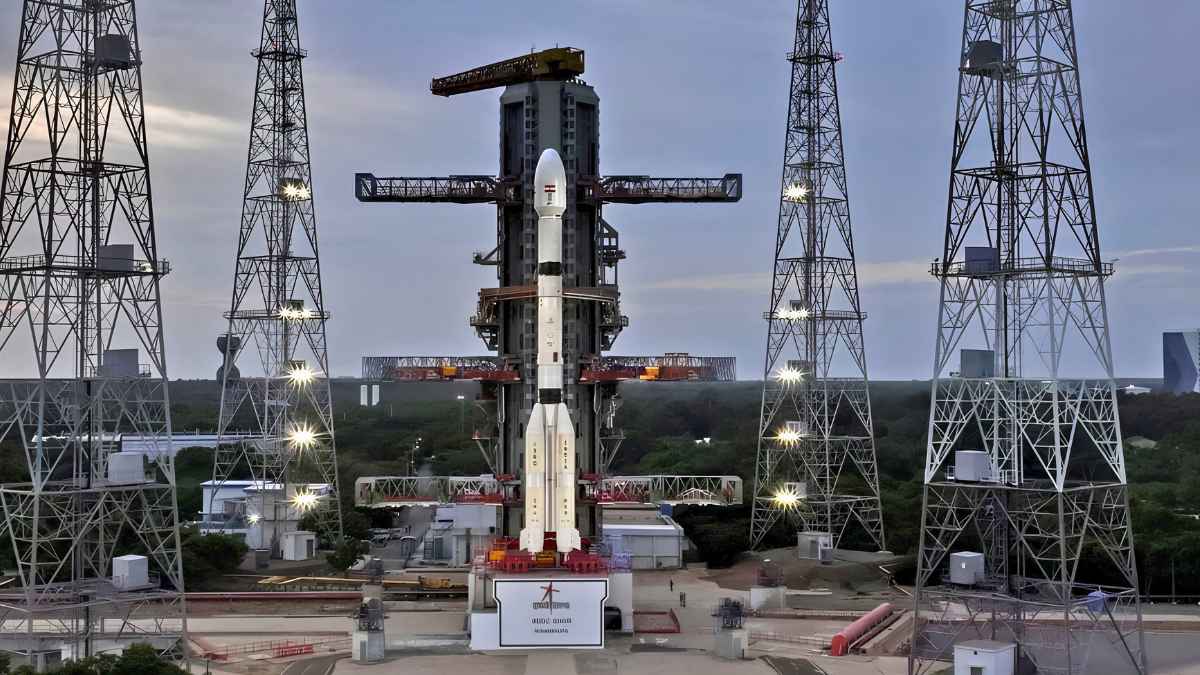
The Indian Space Research Organisation successfully launched EOS-05, an advanced Earth observation satellite, aboard the GSLV-F17 rocket in the early hours of September 4 from the Satish Dhawan Space Centre in Sriharikota.
The rocket lifted off at 2:55 am IST from the Second Launch Pad, and roughly 18 minutes later, the 2,367 kg satellite was placed into its intended sub-geosynchronous transfer orbit. The mission marked ISRO’s first successful launch of the year, coming after a gap of about seven months and following two earlier mission setbacks.
EOS-05 holds particular significance as India’s first dedicated imaging satellite built to function from geosynchronous orbit, at an altitude of roughly 36,000 km above Earth. Unlike satellites in low earth orbit that pass over different regions and revisit locations only periodically, a satellite parked in geosynchronous orbit moves at the same speed as the Earth’s rotation, allowing it to keep a continuous watch over a fixed, broad area.
ISRO Chairman V Narayanan confirmed that the GSLV-F17 had precisely injected the satellite into its planned orbit and that all its systems, including its solar panels, were functioning normally. Mission Director Thomas Kurien described the payload as a uniquely configured satellite capable of near real-time imaging, while Project Director Imteyaz Ahamad called it a complex spacecraft with multi-band imaging capabilities unlike anything ISRO has flown before.
At more than 2,300 kg, EOS-05 is the heaviest satellite the GSLV has carried into a geosynchronous transfer orbit, and Friday’s flight was the 19th outing for the launch vehicle. The mission also carried added weight given the GSLV’s chequered history, including the failure of the GSLV-F10 mission carrying EOS-03 in 2021.
Once fully operational, EOS-05 is expected to support a range of applications, including agriculture monitoring, disaster management and tracking weather events such as cyclones, cloudbursts and thunderstorms over the Indian subcontinent. The satellite will now undergo a series of orbit-raising manoeuvres before it is placed in its final geostationary position.
