

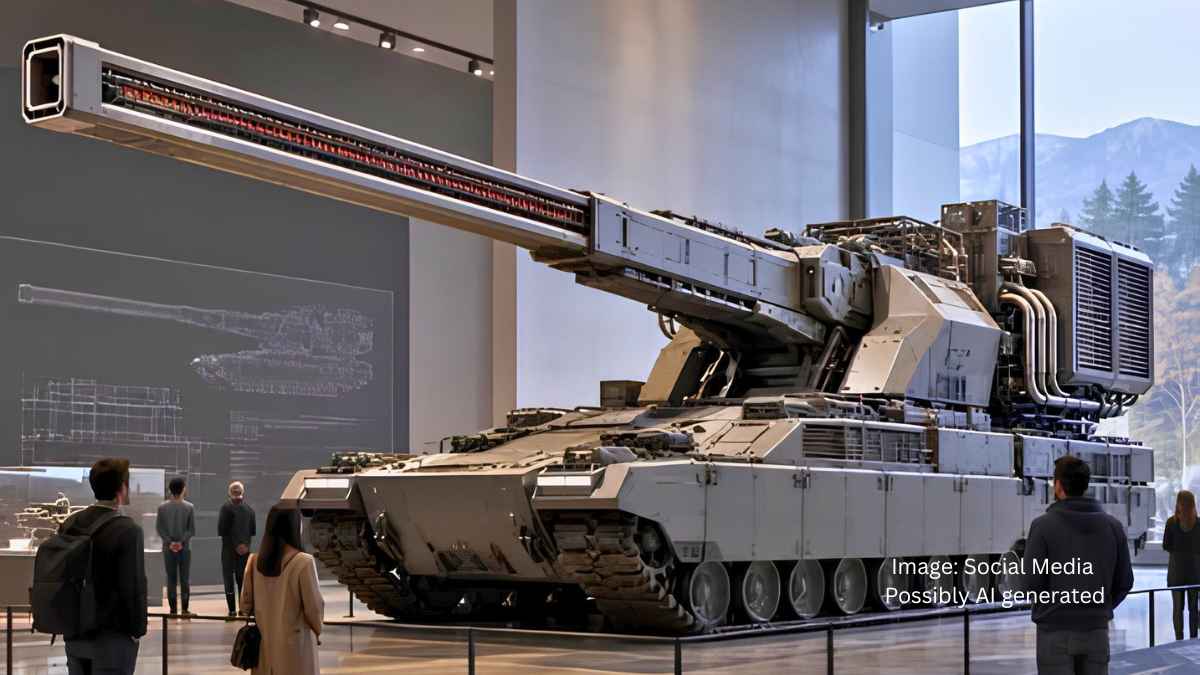
Chinese military researchers have outlined a long-term concept for a nuclear-powered main battle tank fitted with an electromagnetic railgun theoretically capable of striking targets up to 450 km away, a proposal that has drawn global attention even though the system remains firmly in the research stage.
The concept, detailed in a peer-reviewed paper published in June in the Chinese journal Acta Armamentarii, was authored by researchers from Inner Mongolia First Machinery Group, a firm closely tied to China’s tank and armoured vehicle industry, along with the Beijing Institute of Technology.
The proposed vehicle would weigh around 60 tonnes, broadly in line with existing modern main battle tanks, and would be powered by a compact 10-megawatt-class small modular nuclear reactor. Its primary weapon would be a 50-megajoule electromagnetic railgun, a system that uses electromagnetic force rather than chemical propellant to fire projectiles, reportedly capable of accelerating rounds to around 3.5 km per second.
According to the paper, the programme is structured in phases, with an initial version relying on conventional propulsion, a 1,500-horsepower diesel generator paired with a smaller 10-megajoule railgun offering a shorter range of around 150 km, before eventually progressing to the full nuclear-powered variant. Researchers have suggested the complete system could take up to two decades to materialise, with a possible debut sometime after 2045.
Defence analysts have urged caution in interpreting the proposal, noting that it remains an academic concept rather than a confirmed military programme. Significant engineering challenges would need to be resolved first, particularly around reactor shielding, heat dissipation and the practical difficulty of housing a nuclear power source safely within a mobile armoured vehicle. Some military technology specialists have expressed outright scepticism that a nuclear reactor could ever be safely integrated into a combat tank given these constraints.
On whether India should be concerned, most defence commentators note that the system, even if pursued, sits at least two decades away from potential deployment, giving considerable lead time for regional militaries to track its development and respond accordingly.
China has separately made incremental progress on railgun technology in other domains, including reported sea trials of a ship-mounted railgun system, suggesting the broader technology base is advancing even if a nuclear tank variant remains speculative. For now, defence analysts largely view the paper as a signal of the direction Chinese military research is exploring, rather than an imminent shift in regional military capability.
